
Pure Tone Audiometry (PTA )
Home < Services < Pure Tone Audiometry (PTA )
Pure Tone Audiometry (PTA )
Pure Tone Audiometry (PTA) is a standard audiological test used to evaluate an individual's hearing sensitivity across a range of frequencies. It is considered the gold standard for diagnosing hearing loss, determining the type and degree of hearing impairment, and guiding further management and treatment options.
Rating On Google
EMI Facility
Happy Patients
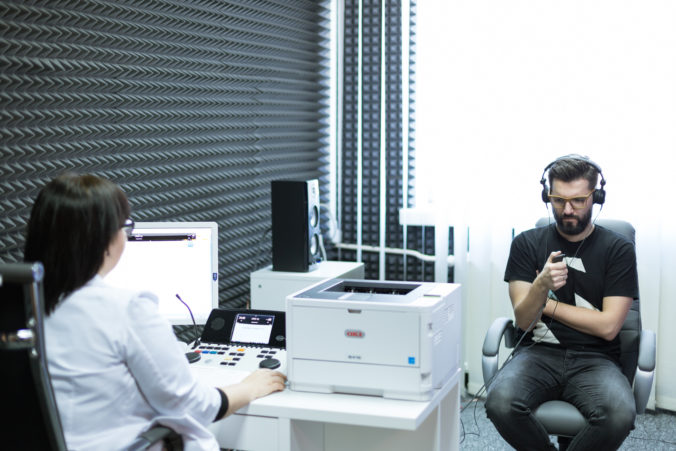
How PTA Works: PTA involves the measurement of an individual’s hearing thresholds for pure tones of various frequencies, typically ranging from 250 Hz to 8000 Hz. The test is conducted in a sound-treated room using an audiometer, a specialized device that generates pure tones at specific frequencies and intensities.
During the test, the patient wears headphones or insert earphones and is asked to respond (by pressing a button or raising a hand) whenever they hear a tone. The tones are presented at different volumes, starting from a level that the patient can easily hear and gradually decreasing in intensity until the patient can no longer detect the sound. This process is repeated for each frequency in both ears.
Air Conduction vs. Bone Conduction: PTA assesses hearing via two pathways:
- Air Conduction (AC): This pathway tests the entire hearing mechanism (outer ear, middle ear, and inner ear) by delivering sound through headphones or insert earphones.
- Bone Conduction (BC): This pathway bypasses the outer and middle ear, directly stimulating the cochlea in the inner ear using a bone vibrator placed on the mastoid bone behind the ear.
Comparing air conduction and bone conduction thresholds helps differentiate between conductive, sensorineural, and mixed hearing loss.
Types of Hearing Loss Identified by PTA:
Conductive Hearing Loss: Occurs when there is a problem in the outer or middle ear, such as earwax buildup, ear infections, or ossicular chain issues. In this type of loss, bone conduction thresholds are normal, but air conduction thresholds are elevated.
Sensorineural Hearing Loss: Involves damage to the inner ear (cochlea) or the auditory nerve, often due to aging, noise exposure, or ototoxic medications. Both air and bone conduction thresholds are elevated equally.
Mixed Hearing Loss: A combination of conductive and sensorineural components, where both air and bone conduction thresholds are elevated, but air conduction is affected to a greater extent.
PTA Audiogram: The results of PTA are plotted on an audiogram, a graph that displays hearing thresholds in decibels hearing level (dB HL) across different frequencies. The x-axis represents frequency (Hz), while the y-axis represents hearing level (dB HL). Each ear’s thresholds are typically represented by different symbols, with air conduction results marked with circles or crosses and bone conduction results with brackets or arrows.
Interpretation:
- Normal Hearing: Thresholds between 0-25 dB HL.
- Mild Hearing Loss: Thresholds between 26-40 dB HL.
- Moderate Hearing Loss: Thresholds between 41-55 dB HL.
- Moderately Severe Hearing Loss: Thresholds between 56-70 dB HL.
- Severe Hearing Loss: Thresholds between 71-90 dB HL.
- Profound Hearing Loss: Thresholds above 91 dB HL.
Clinical Applications: PTA is used in various clinical scenarios, including:
- Screening for hearing loss: Especially in children, the elderly, or individuals exposed to occupational noise.
- Diagnosing hearing impairments: To identify the type and degree of hearing loss.
- Monitoring hearing over time: Particularly in patients using ototoxic drugs or those with progressive hearing conditions.
- Fitting hearing aids or cochlear implants: PTA results guide the selection and adjustment of hearing aids and other auditory devices.
Limitations: While PTA is a valuable tool, it has limitations. It cannot assess the quality of hearing or the ability to understand speech, which is why it is often complemented by speech audiometry and other hearing tests.